





Free-to-Play vs Paid Titles
Let’s talk about console games and what advertising really looks like within this premium inventory. When advertisers and marketers think about console advertising, they often imagine a single type of inventory with large, disruptive video ads appearing somewhere during the gameplay experience. In reality, modern console advertising is built on two very distinct inventory categories and offers multiple approaches to user engagement. They are usually referred to as “Free-to-Play” and “Paid” titles.
Understanding the difference between these two console content consuming types and settings is essential for media buyers. It influences not only the inventory scale and pricing, but also ad format availability, user experience, and engagement dynamics. This article explains how console campaigns can be effectively structured, strategically planned, and practically activated as part of hyper-focused or omnichannel strategies. More importantly, leveraging these two inventory as part of your campaign assets can help deliver the most efficient path of achieving performance and other marketing objectives.
Treating ads on Free-to-Play and Paid titles as interchangeable placements is one of the most common misuses of this valuable and truly unique inventory. By reading this article, you will become more familiar with how these highly immersive digital environments can be leveraged for campaigns and how they can effectively influence gamers in their micro-moments.
Having the right perspective and mindset is essential when testing and exploring new opportunities such as console gaming, therefore you will be introduced to this extraordinary world through practical examples and actionable insights.
Now, Let’s take a closer look at the differences, as well as the shared behavioral patterns, between these two console categories.
Two Inventory Types, Two Different Advertising Environments
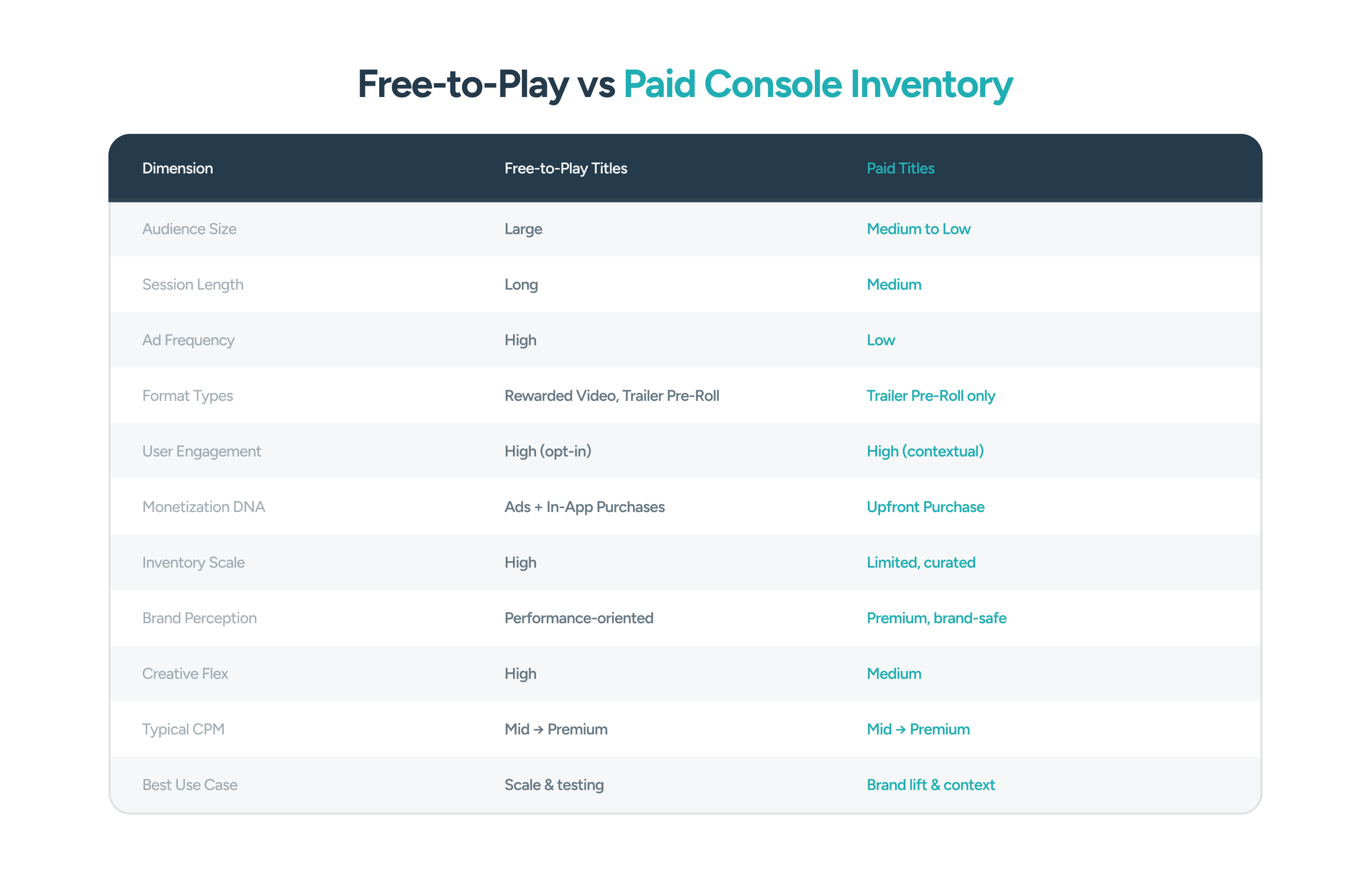
The main and most easily recognisable difference between these two console ecosystems is their users.Free-to-Play games are designed to attract a large volume of audiences based on specific demographics, and generate revenue through in-game purchases in conjunction with advertising, while Paid titles rely primarily on upfront purchases and typically include advertising as a lighter, more contextual layer.
For the purposes of this article, we assume that all inventory complies with applicable regional regulatory requirements and that, where required, users have provided their positive consent for the use of their data for advertising purposes.
To compare this to the traditional digital environment, imagine when you have ads on sites with and without a subscription model. The console has the same principles, making sure the content is profitable, meanwhile the user experience is disruptive or has a mitigated risk of it. The end goal is the same for the advertisers: deliver relevant and quality of advertising messages to the viewership or gamers and fulfill the advertising purposes. From the user experience angle, balancing volume with quality is always the best way to keep both advertisers and users' expectations at an optimal level.
With consoles, these two fundamentally different types can support your campaign objectives in the best possible way. To understand which one is most suitable to serve your campaign outcomes requires a shift in mindset, as within the digital environment, different console types require different frameworks to achieve successful results.
Free-to-play titles tend to deliver higher scale, sometimes at a lower CPM, due to the larger inventory volume, with higher ad frequency.. They are an excellent choice for upper-funnel, brand awareness campaigns.
In contrast, paid titles offer a more niche inventory pool with fewer ad placements and lower ad frequency. They are typically used for mid-funnel, brand consideration campaigns and may come at a higher CPM. Paid console games provide a less commercialised user experience; therefore, ads appear within a more specific inventory and often utilise different ad formats compared to free-to-play titles.
Remember, both environments have value within a marketing strategy, but they serve different campaign objectives, as outlined above.
If you are interested in a practical overview of how these two inventory types are structured in real console environments can be seen in this solutions breakdown, which outlines how Free-to-Play and Paid console inventory is curated,and activated in live campaign executions..
Why Free-to-Play Titles Drive Scale
Free-to-play console games are the backbone of scalable console advertising. Due to their accessibility to a broad audience without an upfront cost, these titles typically attract larger player bases and generate longer session times.
From a tactical perspective, they also provide a strong initial opportunity to collect relevant data sets for post-subscription user retargeting. As a tactical step within the overall strategy, this translates into more frequent ad opportunities and increased exposure within a well-planned console campaign.
In summary, free-to-play titles are often the natural starting point for new console campaigns. They allow advertisers to validate delivery, test creative formats, and build initial reach before expanding into more controlled, premium, and curated environments.
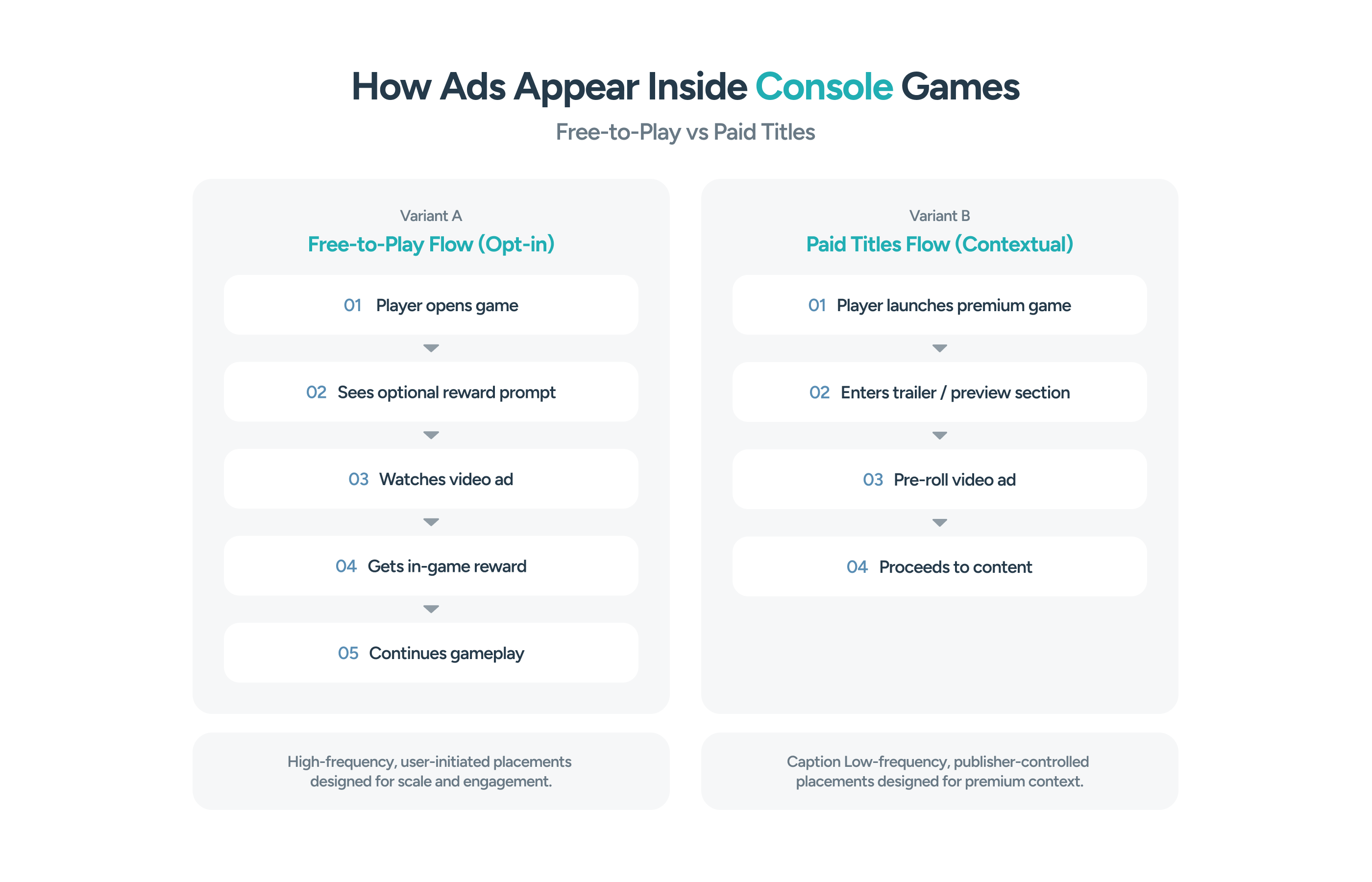
How Ads Actually Appear Inside Console Games: Free-to-Play vs Paid Titles
In practice, ad placements in free-to-play and paid console titles are triggered in very different ways. Free-to-play environments typically rely on opt-in, reward-based moments within gameplay, whereas paid titles surface ads in a more context-led manner. In most cases, these placements sit outside core gameplay and are designed with a lighter, less disruptive approach within the overall user experience.
Despite these differences, both game types deliver advertising messages within highly engaging environments and offer strong active-view potential for brands compared to many other digital channels.
Paid Titles: Curated Placements and Premium Context
Paid console games have a distinct and fundamentally different dynamic compared to free-to-play titles. Because users pay upfront for access, less ad placements and lighter overall ad experience.Ad formats are often limited to trailer pre-roll, and rewarded video is far less common in practice.
Advertising in paid titles is generally perceived as less intrusive and is often associated with a more premium content environment. Due to their lower inventory volume, paid titles are rarely used as a standalone inventory source for console campaigns or within programmatic OMP setups. However, their premium feel makes them particularly effective for reaching a particular segment of console audiences.
When paid titles are combined with free-to-play inventory,they add an additional layer of premium positioning and brand-safe context, enhancing the overall campaign strategy.
Format Availability and Pricing Dynamics
As mentioned at the beginning of this article, one of the biggest misconceptions in console advertising is that free-to-play and paid titles follow the same strategies for campaign delivery, ad formats, and pricing. In reality, they differ across almost every aspect of media planning. These differences are reflected in inventory scale, ad format mix, engagement dynamics, and CPM rates.
In programmatic, different buying types and bidding strategies are also required to maximize performance and optimise ROI. Furthermore a one-size-fits-all is not the best approach when it comes to running a console targeted campaign.
Another common assumption is that paid titles are always more expensive than free-to-play titles. This is not necessarily true. Free-to-play titles can be priced at premium CPMs comparable to paid titles, depending on their audience and other considerations. Meanwhile, paid titles may be priced competitively in certain scenarios, such as seasonal promotions or when they are bundled within a larger deal.
A practical reference point for how format mix and pricing are typically structured in console video inventory can be found in this real-world example, which illustrates how CPM behavior varies across different console environments.
Key Takeaway for Buyers:Paid does not automatically mean more expensive, and free-to-play does not automatically mean cheaper. CPMs should always be evaluated in context, with campaign objectives driving decisions rather than the type of inventory alone.
How Buyers Should Combine Free-to-Play and Paid Inventory
The most effective console campaigns rarely rely on just one inventory type. Instead, they use a layered approach that combines the strengths of both Free-to-Play and Paid titles.
Free-to-Play inventory provides the scale and delivery consistency needed to support ongoing campaigns and budget growth, while Paid titles add a more premium layer that enhances brand perception and reduces ad fatigue by introducing less commercialised environments into the marketing mix.
A practical example of how this layered inventory approach is applied in real console campaigns can be found in this detailed breakdown.
For most buyers, the optimal structure of a console focused campaign ideally would be as follows: start with a Free-to-Play–heavy bundle to enhance brand awareness and campaign delivery with data collection, then gradually introduce Paid titles to improve contextual quality and diversify the campaign assets and objectives between environments.
What This Means for Console Advertising Strategy in 2026
As console advertising continues to grow, understanding the distinction between Free-to-Play and Paid titles will only become more important. Buyers know how to navigate between these two inventory types and how they can efficiently use them as a part of their overall advertising strategy, will be more competitive, better positioned to build scalable, better performing, and relevant console campaigns.
These industry players would change their mindset and ask the right question: “How should I combine both to match my campaign goals?”
And the best answer would be In 2026: Separate experimental console campaigns from structured, high-performing ones. Remember that Free-to-Play and Paid titles are not competing inventory types, they are complementary building blocks of modern console advertising. Free-to-Play titles deliver higher but still engaging premium inventory at scale,higher ad frequency, and format flexibility, while Paid titles provide premium+ user experience, lighter ad experience and more focused campaigns.
For console buyers aiming to achieve both reach and quality in their advertising strategy, it is now clear how to balance free-to-play and paid environments to best meet campaign objectives. This understanding forms the foundation of effective console media planning in 2026.