






Console Advertising in 2026: What Scale Really Means Now
For a long time, console advertising lived in a strange middle ground. It was seen as immersive and premium, but too small, too fragmented, and too unpredictable to play a real role in serious media plans. Brands liked the idea of reaching gamers on PlayStation and Xbox, but most buyers treated console as a niche experiment rather than a scalable channel.
In 2026, that picture has changed. Console advertising has evolved into a Tier-1 video channel that can now support structured brand and performance campaigns across PlayStation and Xbox. What used to be an experimental add-on has become a practical line item for advertisers who care about reach, quality environments, and predictable delivery. The real question is no longer whether console advertising can scale, but what “scale” actually means in today’s console ecosystem.
From Niche Channel to Scalable Video Environment
A few years ago, most console ad campaigns were tied to individual game launches or sponsorship-style placements. Inventory was inconsistent, formats were fragmented, and campaign setup often required manual coordination with multiple publishers. That environment made console advertising hard to trust at scale, even for brands that were genuinely interested in reaching console gamers.
Fast forward to 2026, and the ecosystem looks very different. Modern console advertising inventory now includes dozens of active titles across PlayStation and Xbox, always-on video placements instead of one-off sponsorships, standardized formats like rewarded video ads and trailer pre-roll, and multi-market availability across Tier-1 regions. In practical terms, this means console video advertising is no longer limited to short bursts of activity — it has become a channel that can deliver consistent volume week after week.
A practical overview of how modern console inventory is organized can be seen in this breakdown of structured console advertising solutions.
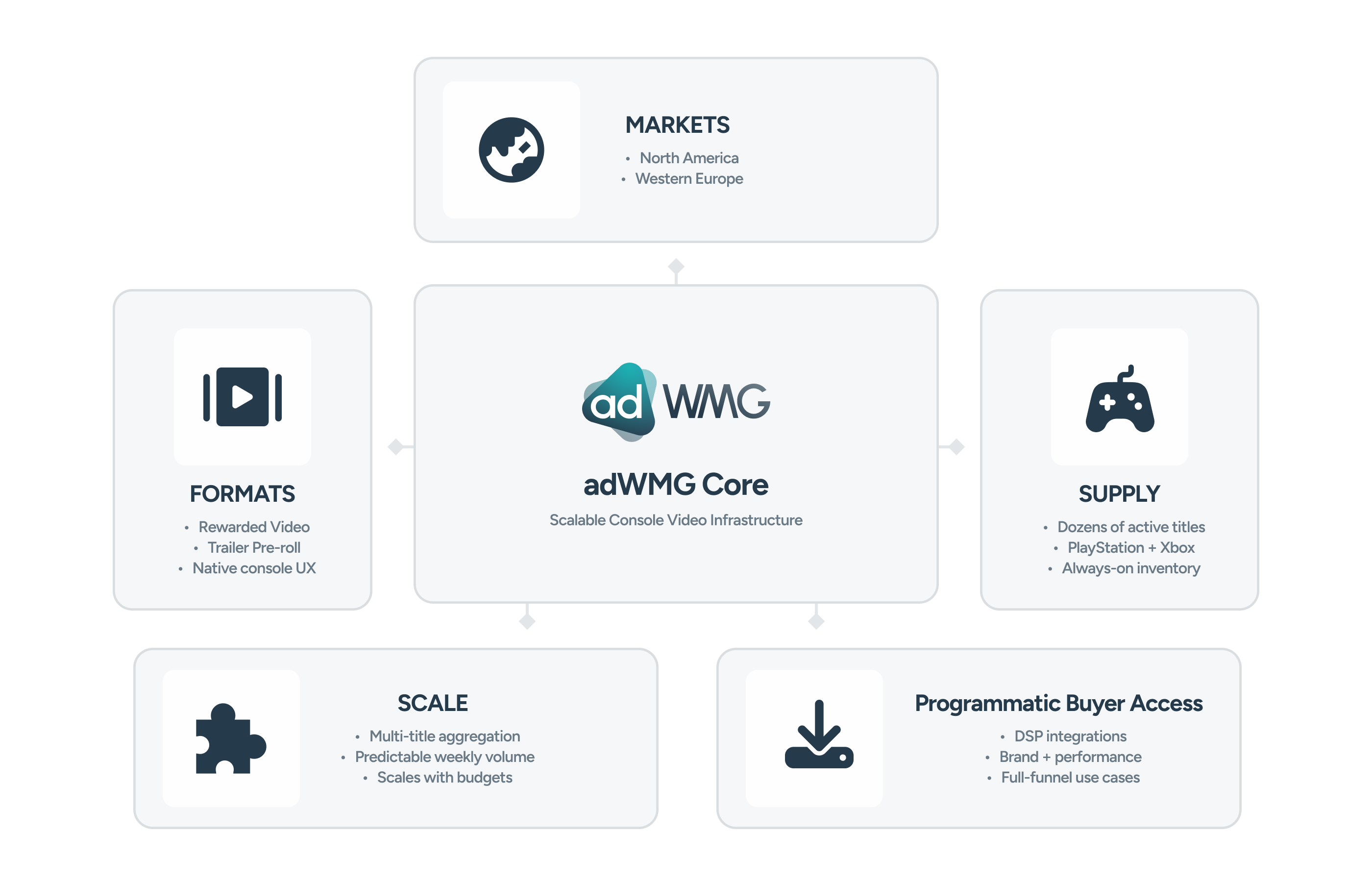
To understand why console advertising can now scale reliably, it helps to look at how modern console inventory is actually structured. Instead of selling isolated placements, adWMG builds a layered, video-first inventory stack designed for predictable delivery and long-term growth
What “Scale” Really Means in Console Advertising
When media buyers talk about scale, they usually think in mobile or CTV terms. Console scale works differently, but it’s no less meaningful. Instead of concentrating volume in one place, modern console inventory distributes delivery across a broad catalog of titles and formats, creating aggregate reach that adds up quickly at the network level.
Rather than relying on one blockbuster game, console advertising supply is now spread across a wide range of active titles. Each individual game contributes a steady flow of weekly ad opportunities, and when those titles are bundled together, they create meaningful reach. This multi-title structure makes console advertising far more resilient than it used to be, as campaign delivery no longer depends on a single hit release or a short-lived spike in player activity.
Formats, Markets, and Continuous Availability
Console advertising has standardized around two core placements: rewarded video ads, where users opt in to watch an ad in exchange for in-game benefits, and trailer pre-roll, where video ads appear before game trailers or content previews inside the console environment. Both formats are video-native and naturally integrated into the gameplay experience, which helps explain why they generate stable delivery instead of sporadic bursts tied to specific content drops.
Scale is not just about how many impressions you can buy. It is also about where those impressions come from. Modern console advertising inventory now supports consistent delivery across major advertising markets, including North America and Western Europe, giving advertisers access to Tier-1 reach without relying exclusively on mobile or CTV.
For readers who want to see how these video-first console ad formats actually appear in live environments, adWMG provides a visual reference across multiple platforms.
This combination of standardized formats and geographic breadth makes console advertising viable for international brand campaigns and global performance launches rather than just local tests. For advertisers who need both reach and geographic control, console has become a realistic alternative to increasingly saturated digital channels.
Why Console Scale Changes the Buying Equation
The evolution of console advertising fundamentally changes what buyers can do with the channel. With predictable weekly delivery and standardized video formats, console advertising is no longer limited to awareness-only use cases or experimental test budgets.
Buyers can now run brand campaigns using trailer pre-roll placements, drive mid-funnel engagement with rewarded video ads, and maintain consistent frequency across multi-week flights. That makes console video advertising a viable part of a full-funnel media mix rather than a one-off experiment that disappears after a short test period.
Console Is No Longer a Bottleneck Channel
One of the biggest historical concerns with console advertising was simple: what happens when I want to scale? For years, that question did not have a reassuring answer. Limited inventory, fragmented supply, and inconsistent availability made it difficult for buyers to increase budgets without running into delivery issues.
In 2026, that concern is far less relevant. With multi-title supply, video-first formats, Tier-1 market coverage, and continuous availability, console advertising can now absorb incremental budget increases without collapsing into delivery bottlenecks. For buyers who rely on predictable pacing and stable weekly delivery, this marks a critical shift from “experimental channel” to a viable part of structured media planning.
Console vs. Mobile and CTV: A Practical Comparison
Console advertising is not meant to replace mobile or CTV, but it no longer belongs in the same category as “experimental niche channels.” It has matured into a distinct video environment with its own strengths and use cases.
Compared to mobile, console offers cleaner environments, lower fraud risk, and less ad clutter. Compared to CTV, console provides stronger interactivity, opt-in formats, and direct engagement moments that are hard to replicate on a living-room screen. For advertisers looking to diversify beyond saturated mobile feeds and increasingly competitive CTV inventory, console advertising has become a practical third pillar rather than a novelty.
How adWMG Approaches Console Advertising
At adWMG, we treat console advertising as a scalable, video-first channel built for real media planning, not one-off sponsorships. Our focus is on creating inventory structures that support predictable delivery and long-term budget growth.
We prioritize native console formats like rewarded video and trailer pre-roll, bundle multi-title supply for consistent scale, and enable campaigns across Tier-1 markets for international reach. A deeper explanation of this model is available in our console advertising framework for brands and agencies.
The New Reality of Console Advertising in 2026
Console advertising has crossed a quiet but important threshold. It is now scalable, predictable, video-first, and international, making it suitable for structured campaign planning rather than short-term experiments.
What was once a niche format for experimental campaigns is now a legitimate media channel with real reach potential. For advertisers who care about quality environments, Tier-1 reach, and predictable delivery, console advertising has become a serious alternative to increasingly crowded digital channels.
Final Takeaway
Console advertising in 2026 is no longer about “trying something new.” It is about accessing a scalable, Tier-1 video channel that sits between mobile and CTV in both reach and engagement.
For buyers who are looking to expand beyond crowded mobile feeds and increasingly competitive CTV inventory, console advertising is no longer a future bet. It is a present-day opportunity.